Please see the updated course description on my Professor Welser teaching site. The course has been substantially updated, and the most current information is linked there.
Bubbles are great - if you're taking a bath. But if you're highly leveraged in the stock market, or are in the business of flipping homes, then bubbles can be dangerous things (as we've all recently learned). In the TED video below, Eli Pariser (founder of MoveOn) talks about another type of dangerous bubble - the Filter Bubble.
You see, even the mighty Long Tail has a downside. While Netflix, Amazon, Google, and countless other web services cater to an individual's tastes, those tastes are never challenged. Netflix doesn't present you with "films you'll probably hate" when you look for your next movie, and Amazon probably won't suggest a different book with the note that "users who bought this book found the following volumes challenging to their worldview." As a result, it's possible to live an online life without ever having to encounter information which doesn't fit into our predetermined narrative schema, and this might already be having real affects on our democratic discourse.
The Group Processes Database lists readings and videos that have been included in the Fall 2009 (coded gray in the reference column) or our current session of 419/519 (coded yellow in the reference column). Open that spread sheet in google docs and take a look at it. Everyone has been asked to complete two tasks:
Identify one of the summaries that you contributed to from the first 5 weeks of the course. Create an entry for it in the data base. See examples starting with record # 45. Make sure you include a link to the resource that you created (google doc write up or blog entry). Take the time to identify relevant keywords for the "Concept" columns. See examples from both 2009 and 2011 that have already been posted.
Note that the readings from 2009 fall into 6 subgroups:
Research methods (yellow highlight concepts in data base)
Technology (red highlight)
Online community (blue highlight)
Social networks (pink highlight)
Collective action (orange highlight)
Social psychology (green)
The readings from 2011 seem to add one major category
Markets and costs (purple)
Your task is to look into identifying potential readings that you want to read and write an abstract for Monday about. The reading needs to deal with one of the four substantive categories that are central to group processes research:
Social networks (pink highlight)
Collective action (orange highlight)
Social psychology (green)
Markets and costs (purple)
To turn in your suggestion, fill out an entry in the database-- as demonstrated by Kyrstal and Kristine.
After you submit the suggestion (including a link to the resource) I will inspect it and either approve it or suggest that you offer another option.
When your entry is approved I will highlight it in green (i.e. you get a greenlight) and type that it is approved as demonstrated by both Krystal and Kristine's entries.
Your suggested readings should either be papers that explain or use foundational theory in the field of group processes, or empirical studies that use such theory or core concepts.
Kristine's addresses social capital (a core concept in social network research)
Krystal's employs a model using status characteristics (a core area social psychology related area of group processes research)
If you have questions you can ask them in the comments of this post.
Further details:
Make your suggested readings by class time on Wednesday.
Sign ups for presentations (5 min max) for Mon and Wed of week 8 will be held in class on Wednesday.
Written versions of your abstracts are due on Monday before class (regardless of day you present)
The template for the abstract is online here: http://bit.ly/lvCi8V
An example of a good abstract from last year is item #24 in the database. (on Chwe's explanation of culture and common knowledge).
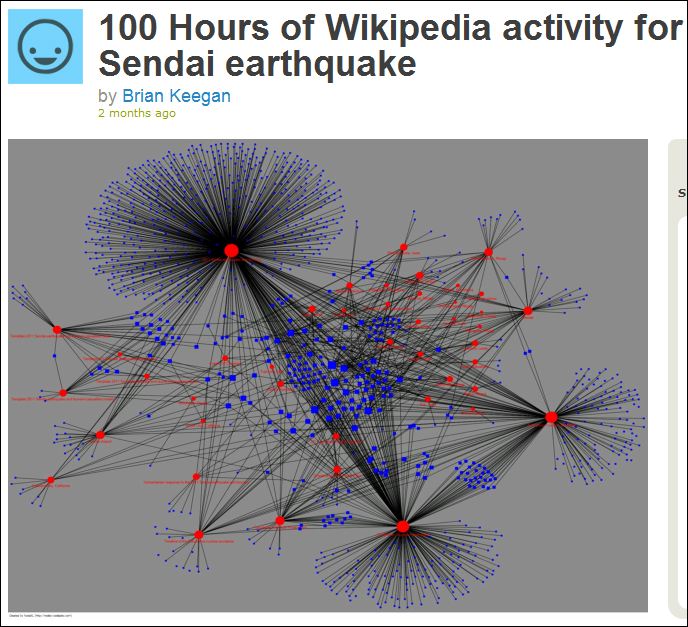
Follow this link to a description/explanation of a video "flip book" that shows the development of connections between Wikipedia authors and pages related to the Sendai earthquake. http://vimeo.com/21088958
To everyone who has contributed or plans to contribute to the record label project we talked about last Wednesday, thanks for all your help! Don't forget to let me know when you've finished at nlcesare@gmail.com so I can start putting everything together.
This blog documents a neat adventure with some interesting connections to different themes from the course so far. He is also doing an AMA at Reddit about his adventure.
Imogen Heap is one of my favorite musical artists, and is one of the few pop stars who I consider a true musician. There are intermittent cello parts during the song "Aha!" on her CD, Ellipse. Imogen Heap decided that while she was touring the CD, she wanted one of her fans in the area to come up and perform the cello part of the song with her. Using a live chat tool called Vokle, she held cello auditions where fans could interact and comment while the auditions were taking place. This represents how social tools have lowered organizational costs, making auditions of this nature possible.
This video captures my two greatest loves: Guided By Voices and Barack Obama, for serious. It is also a great example of a mash-up, though it has a pretty niche viewership - indie rock politicos.
This group of performers use a cappella and beat box vocals to reproduce the sounds of an entire orchestra. Their video has gone viral in YouTube in 2009, which got more than 15 million hits in less than a year. Since then, the Voca People were able to connect with wide audience via the internet, from Tel-Aviv. Now, they have hosted live performances in Europe, which can be equated to concert tours of main stream singers and musicians.
On Monday we talked about the 'long tail' and various related ideas. One neat idea was that we are revealing our true tastes as the supply of cultural stuff expands into the long tail of long tails. So, please post comments with links to songs hosted on YouTube to help us explore a diverse range of songs that folks can now enjoy. Feel free to include songs from the tail and from the popular head of the distribution.
This is a whitewater kayaking video that is incredibly popular among the paddling community. I realize that it is not 'viral' in the sense that millions have seen it, but it is still popular because those people within this sport niche know this athlete specifically, and consider the film important and worth watching.
The songs featured in the soundtrack to this film have since become more popular, and perhaps the few people who were originally interested in the music itself have since become aware of the video. My question is this: how do music and movies relate? For example, how do particular music niches, which may happen to be utilized in a popular film, end up transferring their fans into the group of fans of the film? Or vice versa: do movie lovers end up becoming fans of the musical artists featured in the movie?
The song I am talking about begin at 3:30ish...
This video, a cover of Rebecca Black's brain-killing "Friday", by Matt Mulholland, goes a long way towards redeeming the song. Or at the very least making it less painful to watch. Mulholland takes the song in a completely different direction, stripping away the bubblegum and replacing it with imitation pathos. What's interesting, though, is that the appearance of this video on this blog is only possible through the Long Tail.
Anderson suggests that there are three forces that enable the Long Tail: 1) Democratization of Production, 2) Democratization of Distribution, and 3) Connection of Supply and Demand. To get this video here required first the popularization of the original "Friday" video through blogs, the availability of production tools for Mulholland to make his cover, and again the presence of blogs to spread the word about the cover version. At every step, no Long Tail, likely no cover video.
Successful businesses distribute through on line markets and retail outlets that coexist to serve both the “hits” and the niches. Physical stores have to categorize their stock based on where they think the customer would most likely look for it, like a windbreaker in the “Jackets” section. Online stores can organize products in any way imaginable with a multitude of variables, making them more flexible.
Physical categorization systems are designed so that something can only fit into one category, like the Dewey Decimal System for library books. Eventually libraries created a cross-cataloging system so that patrons could search more variables than just subject, which only became more efficient with the internet. Besides the inflexibility of physical categorization, if something is placed in the wrong section, it can’t be found by someone looking for it.
One of the biggest disadvantages of physical shelf space is that they are bound by geography (products are only available to local audiences). However, online retailers have overcome the boundaries of physical space, tapping the Long Tail of distributed demand in faster and cheaper ways with greater varieties than ever before. The introduction of radio and television also extended demand down the long tail, but they were limited by broadcast slots and forced to focus on a certain number of hits to generate profits.
However, we are now beginning to unlearn the last century’s lessons in distribution scarcity (hit driven media), starting with new generations growing up online. The first wave of “digital natives” turned 18 in 2001, and are now migrating away from broadcast to the Internet, choosing infinite variety and easy ad-dodging online over TV and blockbusters. Hits are the exception, not the rule, and a problem we are faced with today is that many still see an entire industry through this narrow economic lens.
For example, Anderson discusses how Hollywood economics is different from Web video economics, yet when Congress extends copyright terms for another decade at the request of the Disney lobby (or some other large corporation), they’re only playing to the head of the Long Tail. What’s good for Disney is not necessarily what’s good for America; the problem is the Long Tail doesn’t have a lobby, so often they’re ignored.
Lastly, there are many mental traps that we fall into because of scarcity thinking (what the hit-driven, blockbuster industry relies on), and one of the most important is the notion that “too much choice” is overwhelming. (See chapter 10, for further discussion on debunking this myth).
Ebay is an illustration of the long tail in both products and merchants, where non-mainstream items can be sold by ordinary people. Because of the amount of control sellers have over their products, goods that are provided on Ebay are not standardized, leading to its lack of a filter system, of which could expand its productivity.
Companies like Salesforce.com and Google figured out that they could take the cost out of using the long tail in their markets - Salesforce by pooling the efforts of small software businesses all over the planet and Google by using the advertisements of smaller businesses because it’s very low cost.
The emergence of online video has provided benefits to both viewers and networks through instantaneous viewership and through the expansion to new audiences. Although television is still restricted by limited shelf space, the integration of online content with television illustrates the continuing transformation of television through the long tail.
Internet streaming video allows almost anyone to cheaply and easily upload free videos, and people can view those videos at their leisure for free. The ability to watch streaming video helped make the experience more organic, as video was previous always compressed into 30 minute time slots on television (even though most video is much shorter or much longer than that).
Home VCR scared the movie industry because it allowed people to watch videos much more cheaply, but they failed to realize that the improved selection and reduced price would greatly expand the audience.